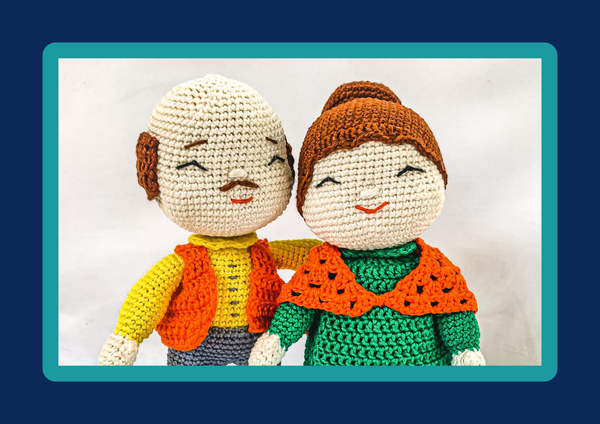
The architecture inside a doily

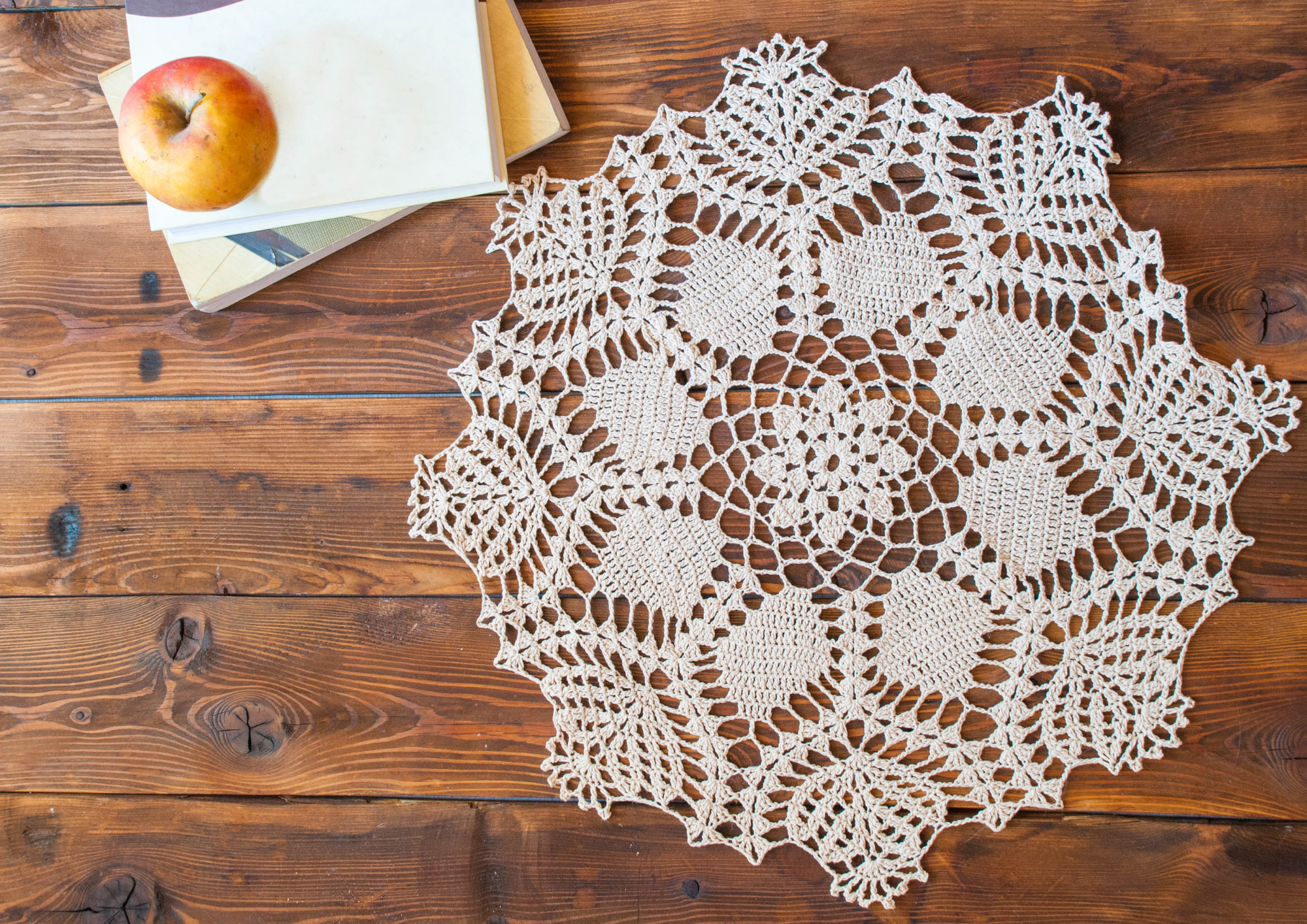
A doily sits on an end table. It is delicate, ornamental, perhaps a little old-fashioned. We recognize the finished object immediately, and rarely think to ask how it was built.
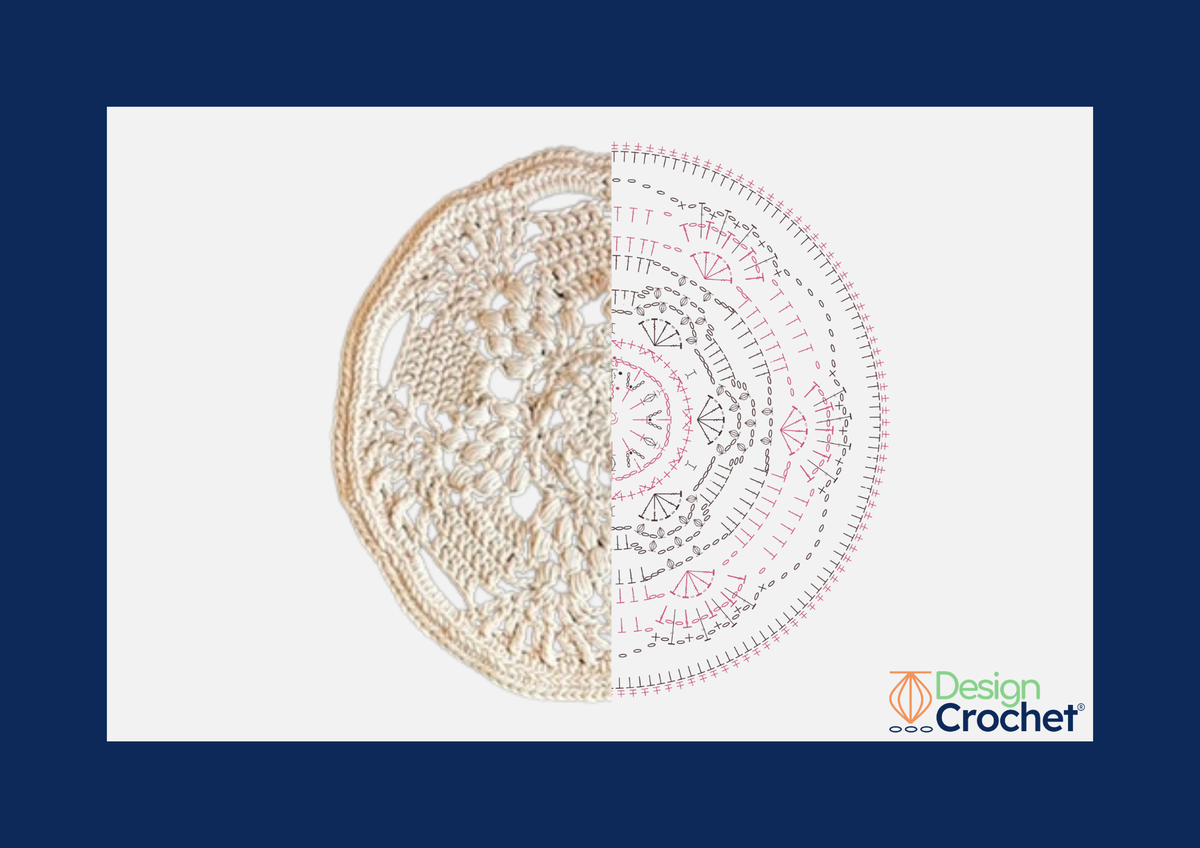
But a crocheted doily is a geometric structure. Its maker must manage a growing circumference, distribute stitches around a center, coordinate local stitch geometry with the shape of the whole, and make hundreds of small decisions that determine whether the fabric lies flat, curls into a bowl, or ripples like a flower.
The architecture is there whether or not we know how to read it.
In my last post, I asked whether the doily could be understood as an object worthy of the same attention we give other forms of human ingenuity: a record of culture, history, passion, and technical rigor. This is the technical half of that question. Because the mathematics inside a doily isn't metaphorical. It is the actual mechanism by which the object comes into being.
A circle is not simply a circle
When we crochet in the round, every new round expands the circumference of the fabric. More stitches are needed to accommodate that growth. Too few, and the fabric begins to cup. Too many, and it buckles into waves.
The challenge is not merely to add stitches. It is to add them at the right rate.
For a flat circular piece, designers establish an increase rhythm that distributes the growing circumference across successive rounds. The stitch counts follow a plan. The plan determines the fabric.
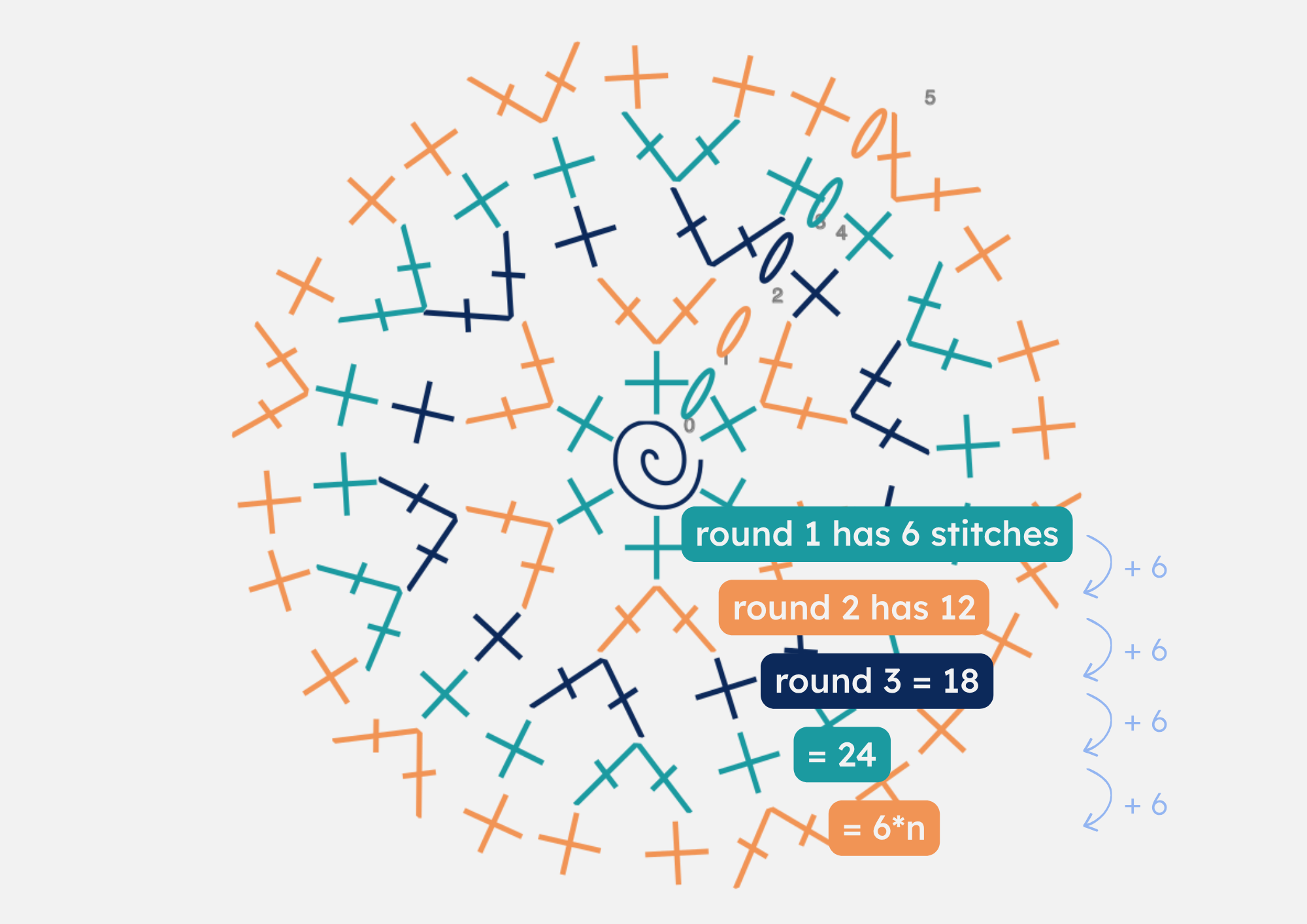
This is a deceptively complex problem. The crocheter is building a two-dimensional surface from individual stitches, each with its own dimensions and placement, while managing the geometry of the whole. A small change in one round can alter the behavior of everything that follows.
The result may look effortless. It is not arbitrary.
A doily is not a circle decorated with stitches. It is a circle constructed out of stitches.
That distinction changes how we see the object. The pattern isn't applied to the structure. The pattern is the structure.
The geometry inside a shell
The problem becomes more interesting when the design moves beyond a simple increase rhythm and introduces shells: groups of stitches that fan outward from a common base to create scallops, petals, and elaborate radial motifs.
Now the designer must coordinate two geometries at once.
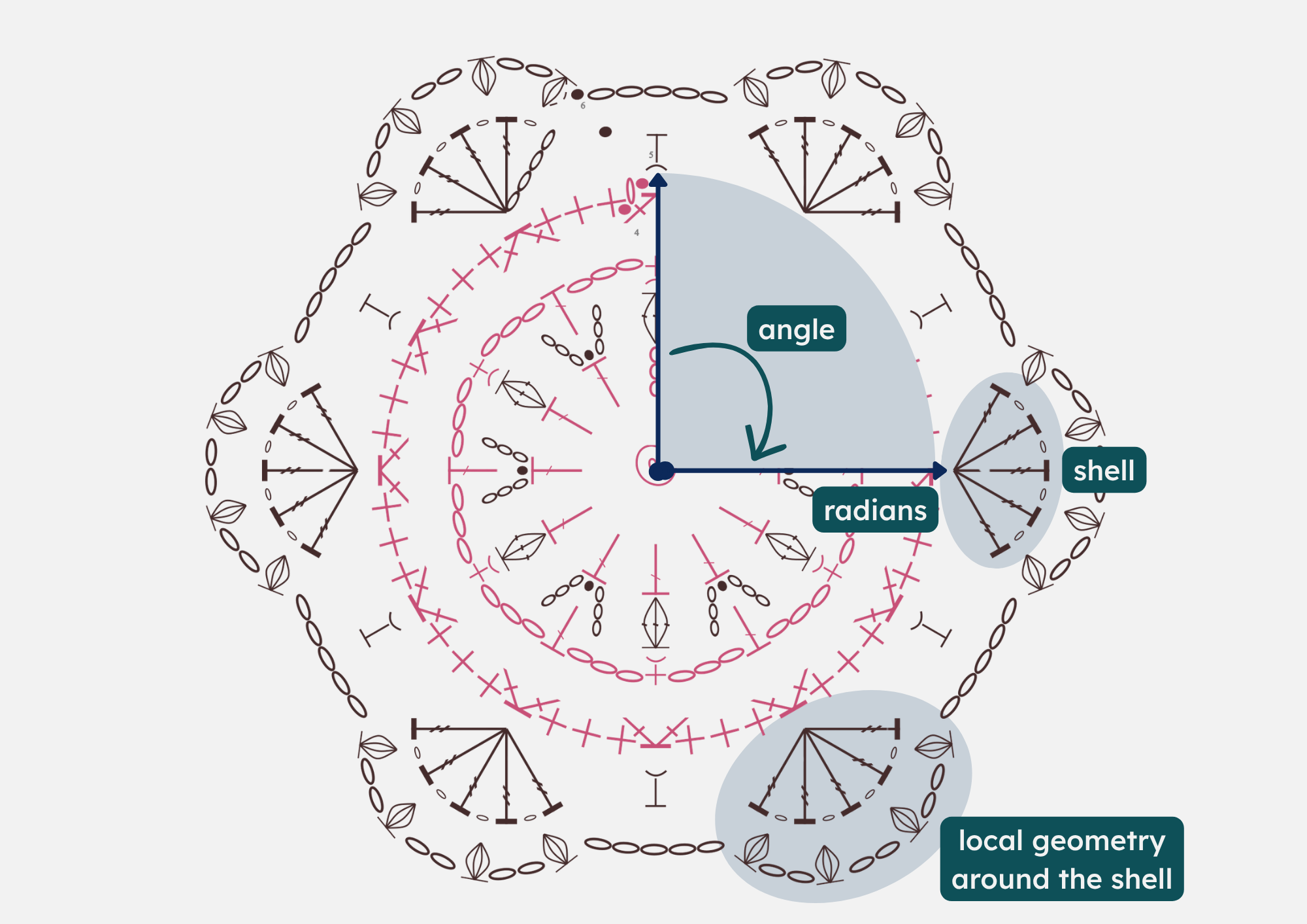
There is the global geometry of the doily: the position of each stitch around the center, its angle relative to neighboring stitches, and its distance from the origin.
Then there is the local geometry of the stitch itself. A stitch has a base and a top. Those points do not occupy the same position, and the relationship between them changes as the stitch rises, leans, or fans outward.
In a shell, several stitches share a base region but spread across different angular positions at their tops. To represent the structure accurately, a designer must account for how those local relationships fit within the larger circle.
This is where radial geometry becomes practical. Angles and radii are not abstract quantities added to crochet after the fact. They describe where the stitches must go.
The challenge is one of nested systems: the geometry of each stitch, the geometry of the shell, and the geometry of the entire doily must work together.
Think about what this means for the person designing the piece. They are not simply choosing a pretty arrangement of stitches. They are coordinating a set of local rules to produce a global form, often while accounting for the physical behavior of yarn and the limitations of the stitch structure.
This is the kind of problem that belongs just as naturally in a conversation about spatial design as it does in a conversation about craft.
Yet the finished object is still likely to be described as cute.
The blueprint we never learned to see
Crochet has a peculiar relationship with its own complexity. The technical decisions are embedded in the making, but they are not always visible in the finished object. The work looks soft. The process is repetitive. The result is often ornamental.
So we mistake the appearance of the object for the difficulty of its construction.
Mass production reinforces that habit. Most of the textiles and decorative objects around us arrive finished, their construction decisions hidden inside industrial processes. We rarely see the underlying instructions, calculations, or tooling. We judge the result by its appearance.
Handmade crochet offers a different kind of construction, but we have not developed a widely shared visual language for explaining its complexity. Pattern notation exists, of course. So do charts, diagrams, and generations of accumulated design knowledge. But the tools for representing crochet's spatial logic have not kept pace with the possibilities available in other forms of digital design.
We have the objects. We have the knowledge. What remains unevenly developed is the infrastructure for making the construction legible.
And that matters because invisible complexity is easy to undervalue.
When the mathematical decisions disappear from view, the labor can disappear with them. The maker's work is reduced to patience and dexterity, as though the hands were simply repeating motions rather than executing a design.
The architect disappears behind the ornament.
Numbers on the wall
I was struck by a different approach to this problem when I visited the Las Vegas Sphere.
From the outside, the Sphere is an enormous illuminated spectacle. Its surface dominates the skyline, and the experience invites you to look at the finished form. You can appreciate its scale and visual impact without knowing anything about how it was conceived or constructed.
Inside, the experience of its architecture changes. In the public spaces, gold lettering and symbols make mathematical and technical ideas part of the visual environment. The building's underlying logic becomes something you can encounter, not merely something you must trust is there.
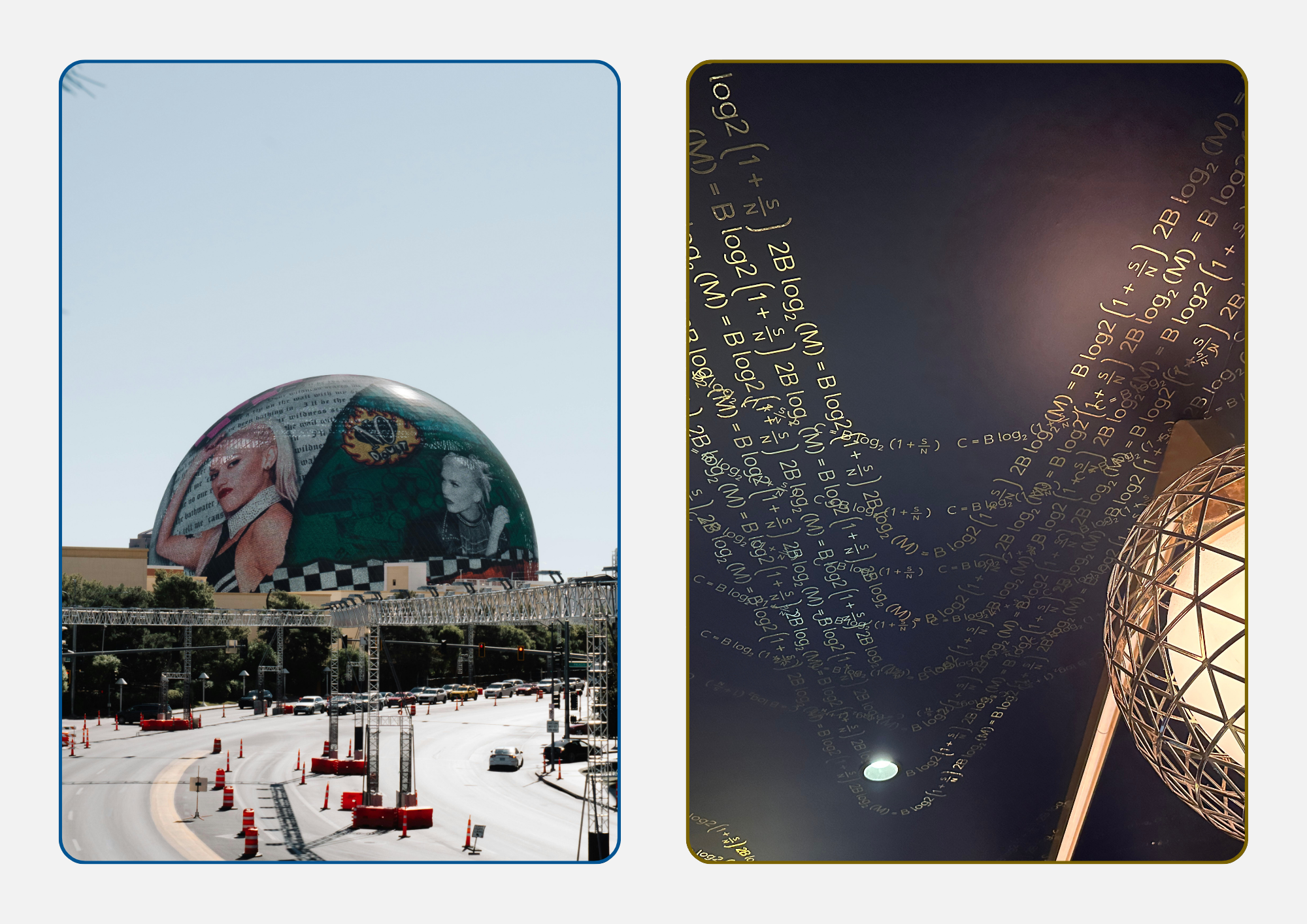
The point is not that a crochet designer and a building engineer solve identical problems. They don't. The materials, scales, constraints, and consequences are different.
The point is that a structure can be made more legible by making its underlying logic visible.
The Sphere gives its audience a way to look beyond the spectacle and consider the systems that make the spectacle possible.
Imagine bringing that same impulse to a doily.
Imagine a chart that doesn't merely tell you which stitch comes next, but helps you see why the stitch belongs where it does. A visualization that shows how each shell occupies the circle, how the bases and tops of the stitches relate, and how the increase pattern shapes the fabric. A way to move between the individual stitch and the complete design without losing sight of either.
The chart would still be a practical tool for making the object. But it could also be a window into the designer's thinking.
The blueprint would no longer be hidden in the finished fabric.
Making the invisible visible
I don't believe crochet needs to prove that it is mathematical. The mathematics is already there. Nor does every crocheter need to calculate radians before picking up a hook. A person can make something extraordinary without describing its geometry in technical language.
But makers deserve tools that can express the full sophistication of what they do.
For too long, the cultural framing of crochet has encouraged us to look at the softness of the material and overlook the rigor of the construction. The result is a strange contradiction: an intricate, engineered object is treated as though its complexity were incidental to its beauty.
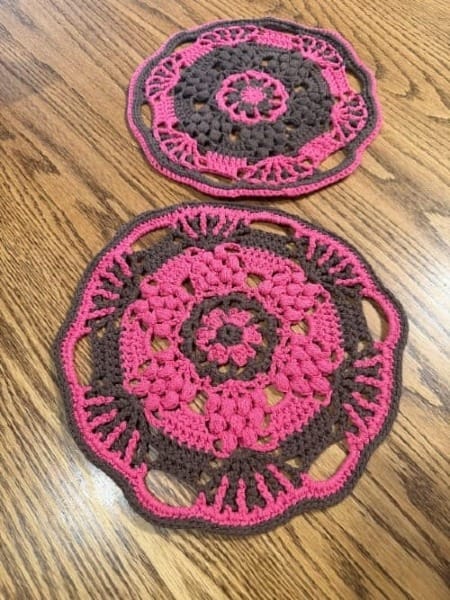
It isn't incidental. The geometry is part of what makes the beauty possible.
Design Crochet is my attempt to make more of that underlying structure visible: to create tools for designing, visualizing, and reading crochet patterns that bring the spatial logic of the craft into view.
Not to turn crochet into something it isn't. Not to make every maker into an engineer. And certainly not to strip away the history, pleasure, or humanity of working with yarn.
The goal is to give the architecture inside the doily a blueprint people can actually see.
The doily was never just decoration. We simply haven't always known how to look at it.
Want to explore on your own?

Open a project in the Design Crochet workspace and try a simple radial chart. Paste the lines below into Code Studio, then create or append so you can see the circle build round by round.
A classic flat-circle rhythm (even increases):
"mr",
"ch1!=sc, sc.6, sl st",
"ch1!=sc, 2 sc inc.6, sl st"
That is the increase plan from earlier in this post, written as code: same multiple each round so the fabric can stay flat. Make the chart today. Then change one round (add too many sc2, or too few) and watch the diagram show what cupping or ripples look like before you ever pick up yarn.