Why Crochet Patterns Are Still Stuck in PDFs (and What Comes Next)
I first realized the PDF format was failing crochet—not as a minor inconvenience, but as a real blocker—on an airplane.
I’d boarded with a complex hat project, and I’d forgotten to print the pattern. The internet was shaky, so I did what anyone would do: I downloaded the PDF to my phone and figured I’d manage.
I couldn’t.
Not because the pattern was “bad,” but because the medium was wrong for the job.
The airplane test: when the pattern is on your phone, the cracks show immediately
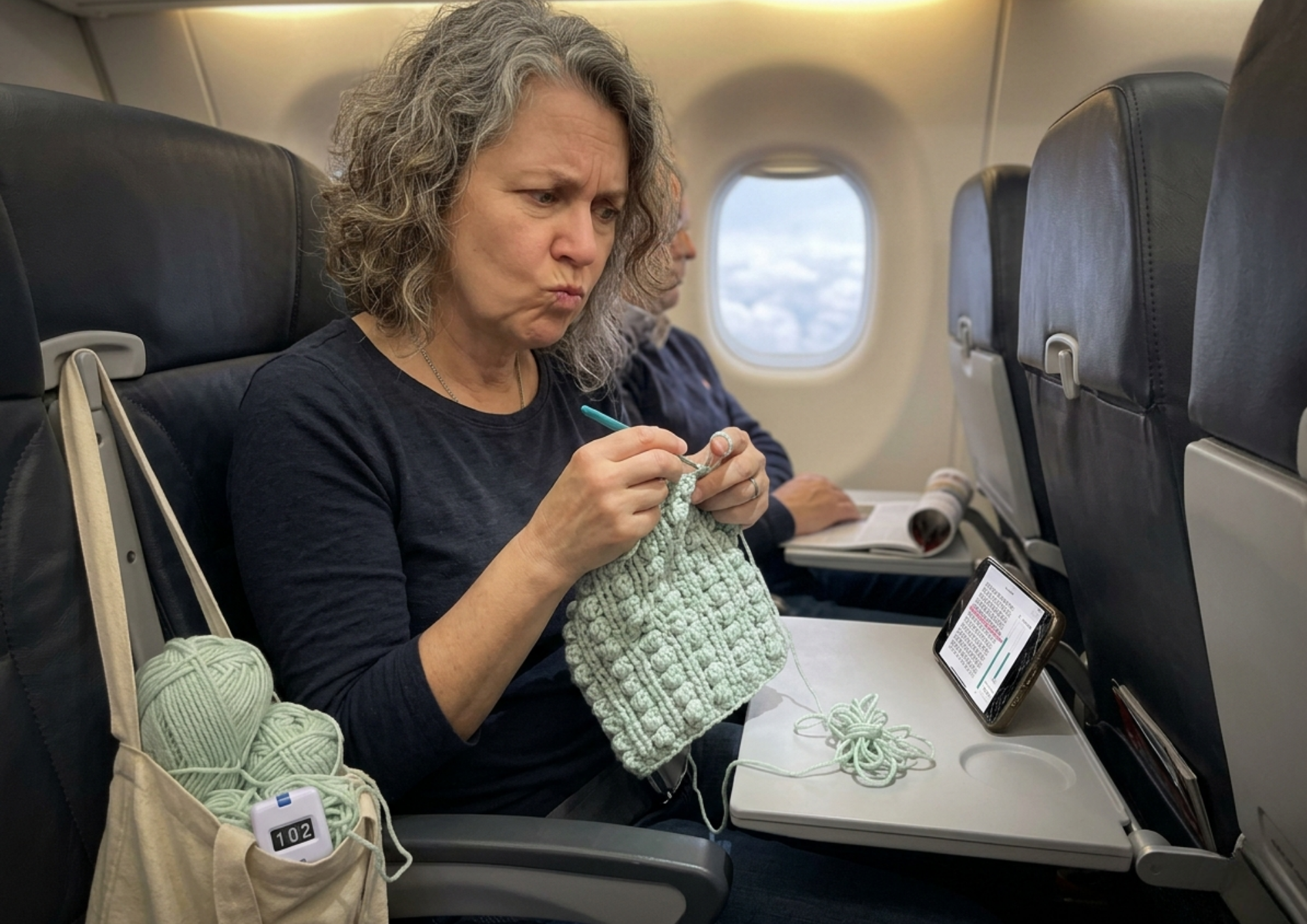
The hat had a chart—symbols, rounds, placement cues—but the chart and the written instructions weren’t integrated. So the experience became an endless loop:
- Scroll the written instructions
- Flip back to the chart
- Try to decode where the hook actually goes
- Flip back again because you lost your place
- Repeat, until the joy drains out of the craft
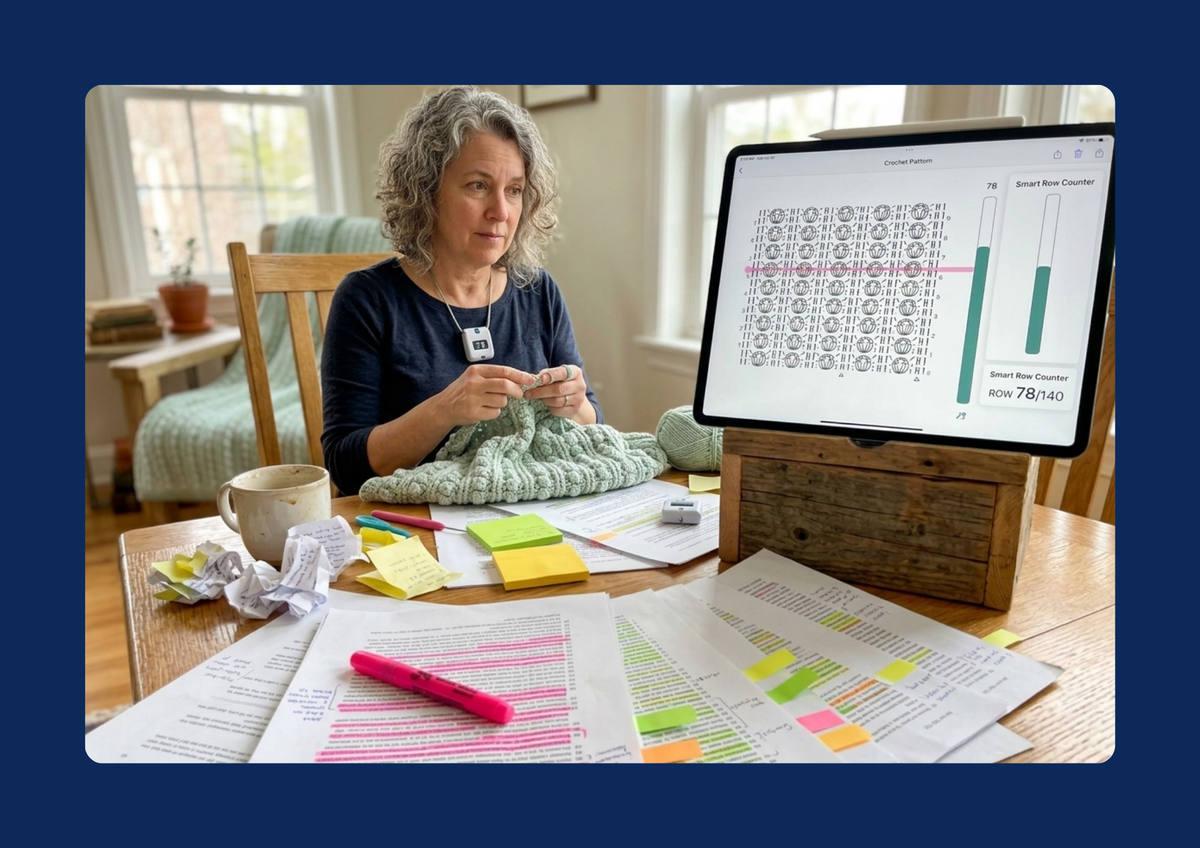
On paper, you can spread pages out and mark them up. On a phone, you’re trapped in a tiny viewport where every context switch costs you.
The second problem was progress. If I closed the file, the PDF didn’t reliably preserve where I was. So I had three options, none of them good:
- Jot down the round number somewhere else,
- count back from the beginning, or
- just remember.
In practice, I did what most people do: I tried to brute-force it. That meant working, unwinding, and reworking the same round over and over. The frustration compounds quickly when you’ve had to frog the same section three times—not because crochet is hard, but because the interface is fighting you.
And then there’s the third crack: help is never in the right place.
Even when you know how to crochet, modern patterns assume you’ll constantly context-switch to relearn micro-details:
- How many loops are in this puff again?
- Which variation of shell does this designer mean?
- Is this the stitch I learned, or a different definition with the same name?”
Tutorials live on different pages, different sites, different tabs—so every time you go looking for clarity, you risk losing your spot.
That airplane session made one thing obvious: PDFs were built to be shared—not to be followed.
The people hurt most aren’t beginners. They’re ambitious intermediates.
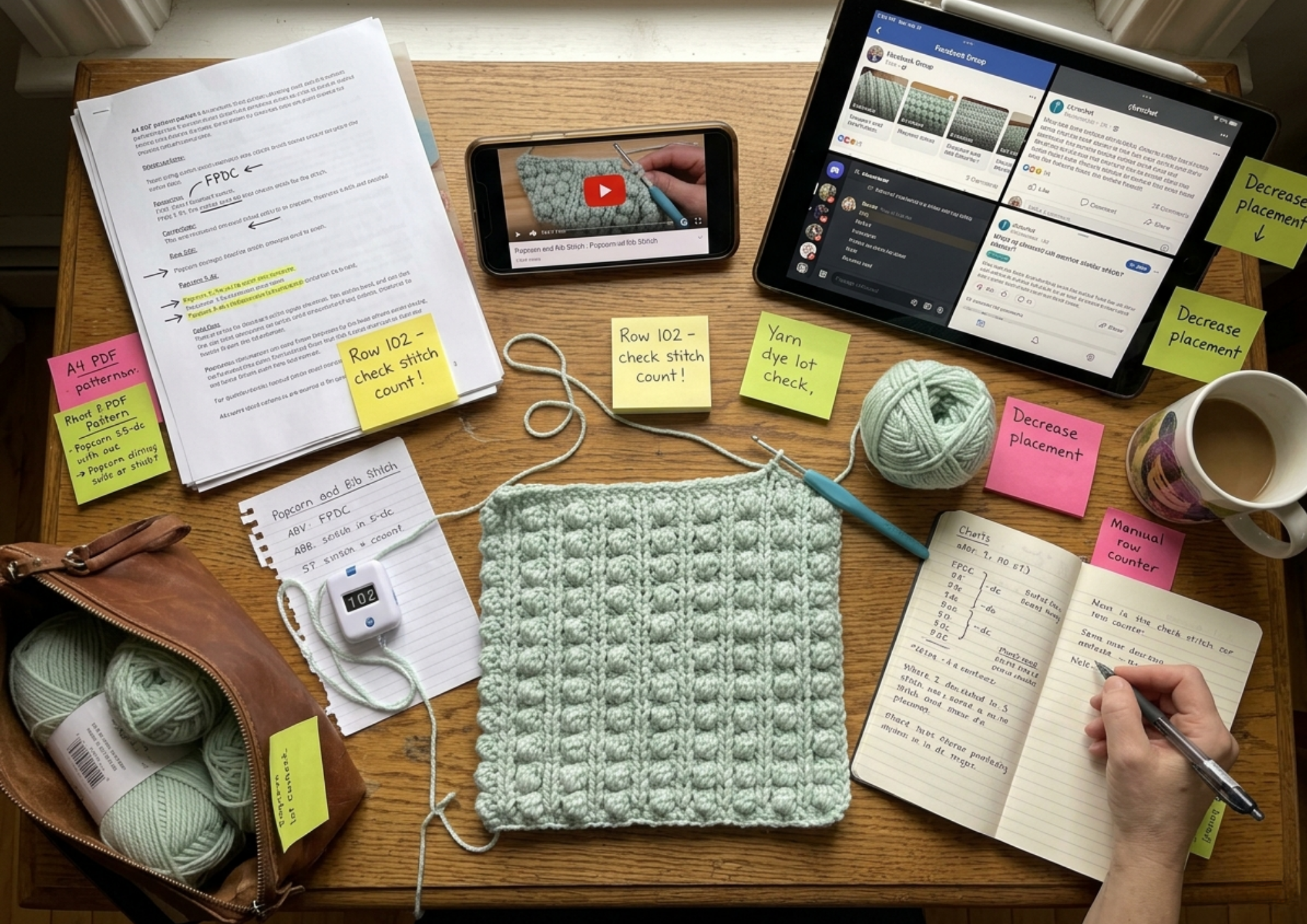
The makers who suffer most aren’t absolute beginners. It’s the ambitious intermediates—the people who’ve learned the basics and are hungry to go deeper. They’re ready for more elaborate designs, charts, and texture, but they hit a wall that has nothing to do with creativity and everything to do with information design.
When they get stuck, the workaround is almost always the same:
- DM the designer and wait
- Ask in a community group and hope someone answers
- Hunt YouTube for a technique that might match what the pattern means, or
- Simplify the project and avoid the complexity entirely.
That lag matters. It interrupts the flow state that makes crochet feel like meditation. And it quietly pushes people away from the very kinds of patterns that expand their skill and enjoyment.
Designers pay the “PDF tax,” too
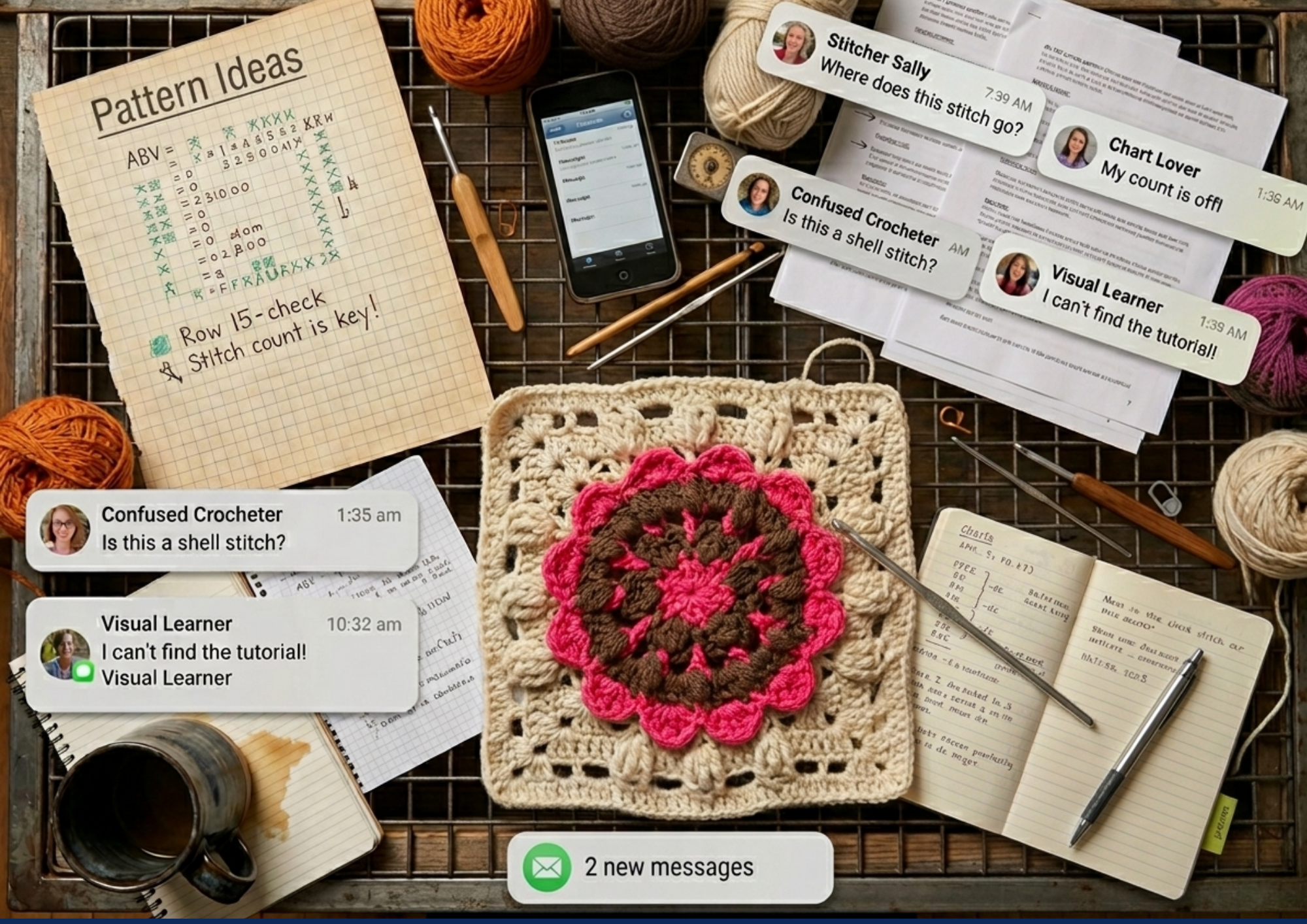
From the outside, crochet pattern writing can look straightforward: write the steps, export a PDF, sell it.
But the real work shows up in the questions.
Based on my experience teaching and supporting makers, the repeat offenders are painfully predictable:
- Hook placement confusion: Crochet terminology isn’t standardized enough, and patterns get harder faster than most stitch guides prepare people for.
- Stitch count misunderstandings: People lose track, patterns omit counts, or counts don’t feel connected to what the maker sees.
- Conflicting definitions: The same stitch name can mean different constructions depending on who taught you.
- Technique context gaps: Patterns teach the steps but not the concept—like what a shell really is and what variations exist.
- Video mismatch: Tutorials and patterns live in separate discovery ecosystems, so finding the right help is harder than it should be.
Every one of these questions costs time—time designers would rather spend doing the part of the job they love: designing. It also adds stress, delays maker progress, and can create reputational damage when a perfectly good pattern becomes “hard” simply because the format forces confusion.
How we got here: PDFs were the best available tool, until they weren’t
Patterns started as written documents—journal notes, printed publications, written instructions passed through communities. When personal computers arrived, designers used the tools that existed: document editors. Then came the natural next step: PDFs, because they’re portable, consistent, and easy to sell as a downloadable attachment.
Platforms like Etsy and Ravelry made the workflow simple: upload a file, sell a file, deliver a file. So PDFs became the default for independent designers.
That made sense—then.
But the world shifted. Makers don’t live at printers. They live on phones and tablets. The craft became more global and more social. Complexity increased. Expectations increased. And the PDF stayed frozen in time.
The killer capability: the right information at the right time
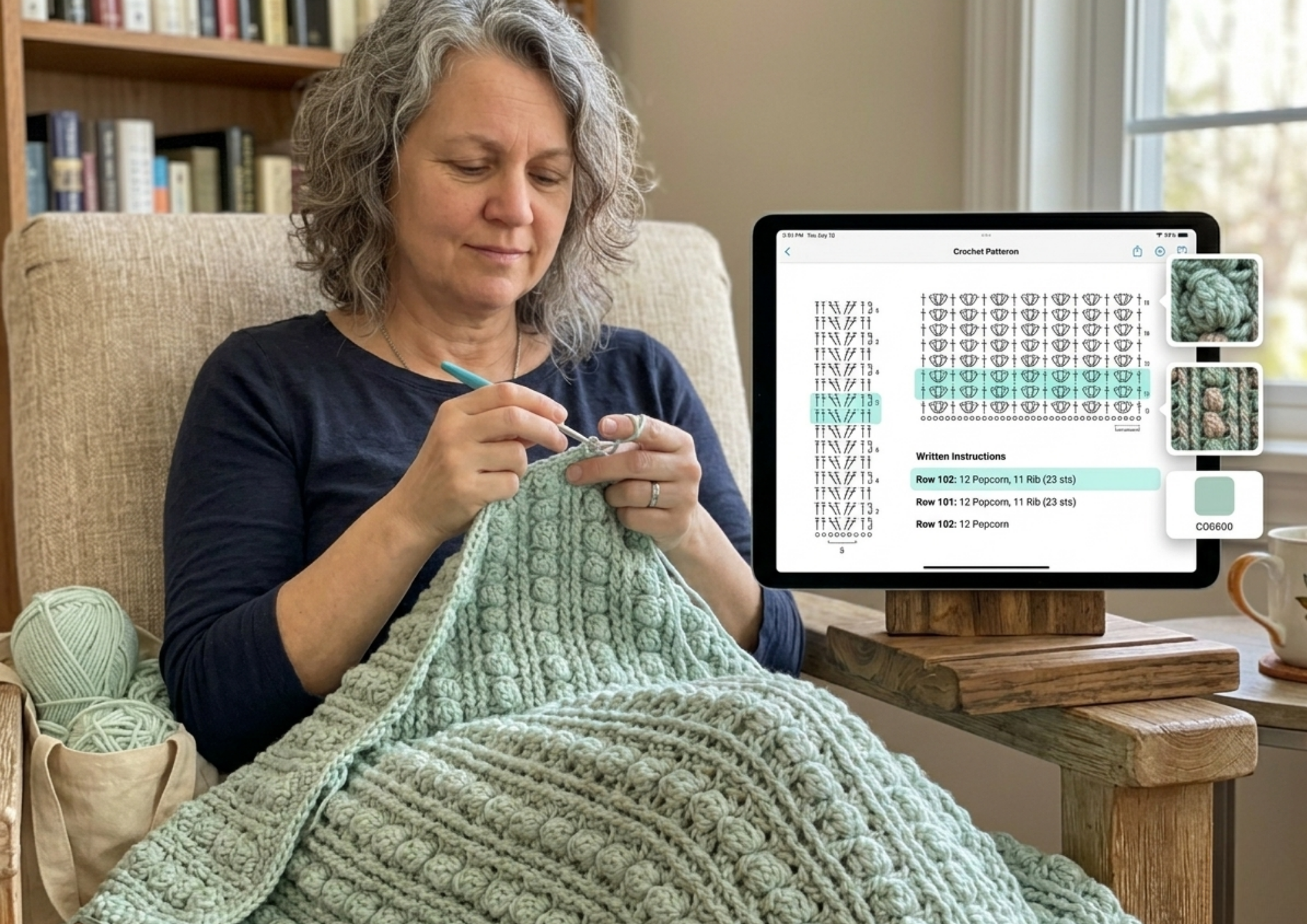
What do modern crochet tools need to do that PDFs fundamentally can’t? Deliver the right information at the right time.
That sounds simple, but it’s a deep design principle. It means:
- interactive charts that reveal one row at a time,
- written instructions that sit directly alongside the chart for that exact row,
- embedded stitch help that doesn’t force you to lose your place,
- tutorials and even videos within a tap when you need a refresher, and
- visual “what yours should look like” references at each step.
Not more content. Better timing.
Like legos: patterns as building blocks, not pages
When I think about modern pattern tooling, I don’t think about documents. I think about building blocks.
A pattern is a composition of stitches. If you treat each stitch like a brick, and you understand the anatomy of those bricks, you can make patterns more readable and more teachable.
Even a single stitch can be broken down into components that remove ambiguity:
- Base: how the stitch is placed. this includes standard placement vs. modified placement (post stitches, FLO/BLO, middle bar, etc.), plus symbol definition and tutorial support.
- Post: the body/height of the stitch Yarn overs (like a dc), multiple posts (like a puff), and the parts that control structure.
- Top: how the stitch finishes and how the next stitch “sees” it Some stitches have advanced finishing (like popcorn), and the top also acts as a clear placement cue.
In this model, what the maker sees at any moment isn’t a page. It’s the repeat they’re currently working on—one clear unit at a time.
The uncomfortable truth: we have an incentive problem (and it shows up as a copyright problem)
There’s a strong anti-technology culture in crochet, and I understand why. Many people love crochet because it pulls them away from doomscrolling. Building an app can sound hypocritical: why put more screens into a craft that’s supposed to be calming?
But the deeper fear isn’t screens. It’s intent.
People fear new technologies because they believe tools exist to replace people. The reality is more nuanced: good tools change what the work becomes. If you build technology designed to elevate creators—to help makers succeed and help designers spend time designing—people don’t fear it the same way they fear feed-based social platforms engineered for distraction.
And that brings us to copyright.
Right now, the ecosystem is misaligned:
- PDFs are easy to copy and resell with minimal effort.
- There’s little structural vetting for quality or correctness.
- Designers can be undercut by straight reposts.
And increasingly, people can mass-produce low-quality, AI-generated “patterns” to make a quick buck.
In healthier creative ecosystems, credit creates a network effect. Academia has lineage: you cite sources, you build on ideas, and the web of attribution helps everyone learn faster.
Crochet doesn’t have that—not because creators don’t want to credit, but because each individual “paper” (pattern) is monetized in isolation. There’s little incentive to show your research trail when your revenue depends on selling the full artifact.
A modern platform could change that—not by trying to police creativity, but by making variation natural and attribution default.
Why interactive tooling changes the economics of stealing
The point isn’t to turn crochet into DRM.
The point is: if people are buying an experience, not a file, simple copying stops being worth it.
Interactive patterns are harder to replicate because the value isn’t just text on a page. It’s structure, interactivity, context, and guidance—delivered at the right time.
And beyond deterrence, modern tooling can do something healthier: embrace remixing and credit lineage. Makers love variation. That’s the creative heart of the craft. The right system can make it easier to adopt a pattern, customize it, and still attribute the original designer—so credit and value flow through the ecosystem instead of getting lost.
It’s early for the full vision, but the direction is clear: make pattern adoption and customization easier, and track that journey on-platform in a way that benefits original designers and remixers.
What “v1 lineage” could look like: structured resizing without rewriting
The smallest believable version isn’t a grand revenue-sharing bureaucracy.
It’s something practical: a published pattern with the ability to change size inputs.
Imagine taking a tea towel stitch pattern and transforming it into a scarf by changing specs—without rewriting the entire set of instructions. Designers can do this today with manual math and re-authoring, but it’s time-consuming and makes publishing feel like duplicating work.
If the stitch pattern becomes the input, a tool can help generate the written output to fit new specs. The creator gets to spend time on design—not document maintenance.
The hero feature: row-by-row charts with instructions side by side
If you want to understand what “modern tooling” means, don’t start with buzzwords. Start with one moment of relief:
You open a motif. It’s short—five rows. Each row is displayed clearly and painted in the yarn color you want to use. On the same screen:
- the chart for the row is front and center,
- the written instructions sit alongside for extra clarity,
- there’s an image of what the result should look like, and
- stitch tutorials are one tap away.
Instead of overload, you get a single clear step. The mental load collapses. It feels obvious—like this is how it was always supposed to work.
A five-year north star: a central hub that makes makers more successful
In the world I’m building toward, the experience feels cohesive:
- Before purchase: makers can explore materials and visualize outcomes so they know what they’re making before they commit.
- First stitch: the pattern doesn’t intimidate; it teaches. Tutorials are present at every step, not hidden behind searches.
- Getting stuck: it’s rarer, but when it happens there’s an easy way to ask for help from the designer and from makers who already completed the pattern.
- Finishing + sharing: sharing is polished and simple, and your variations are captured as you go.
- Remixing: publishing a remix becomes a button-click, because documentation happens in-line as part of making.
The difference isn’t “more features.” It’s that learning and making stop being scattered across PDFs, tabs, DMs, and social feeds.
If you want to help shape this, here’s what I need
I’m recruiting collaborators across the ecosystem—because making this real requires designers, makers, and sellers building together.
- If you’re a yarn seller: visit our partner page. I want to hear firsthand how I can help get your product in front of the right audience. I also have a prototype that helps visualize your colorway directly on a pattern.
- If you’re a maker: test the pattern demo and tell us what you think—what felt magical, what felt confusing, and what you wish existed.
- If you’re a designer: I want your feedback on what you need to publish patterns in a format like this. If you want a low-risk way to contribute, start by sharing a stitch in the community stitch dictionary—your contribution is tied to your name and remains attributed to you. If you’d prefer contributing in a paid/private way, message me directly and we’ll talk.
We’re moving patterns off PDFs and onto an interactive, mobile-friendly app—so makers are more successful, and designers can focus on designing.